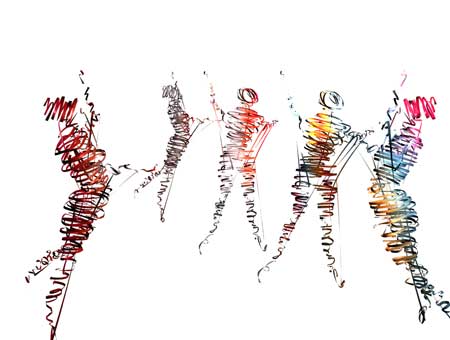
 Being an art enthusiast I have always known mathematics came into play when creating an art piece. Obviously, some more than others, however, to create art no matter what it is or how you do it, utilizes a combination of both creativity and precision. Within Tactile Kinesthesis by Charles Csuri you can see through his description on how he uses flows of functions, procedures and algorithms to create his piece on the computer. Even though it seems like lines on the screen, it is precision that is used to crest this masterpiece.
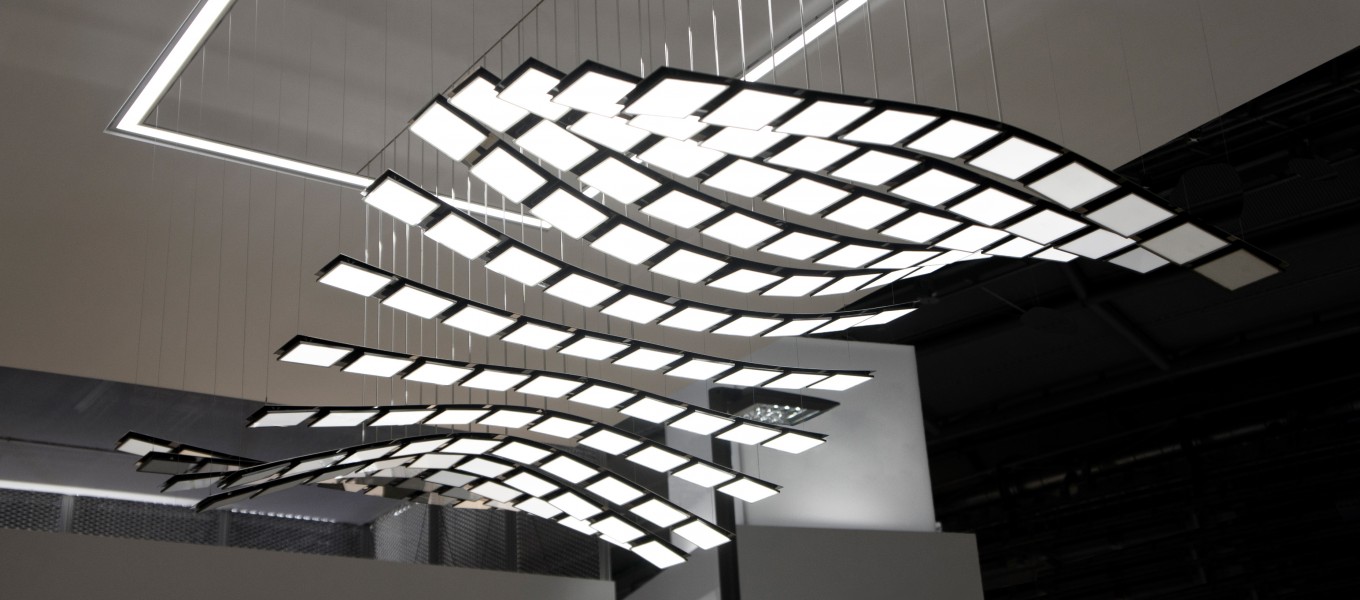
Art that comes from our imagination or a re-creation of something we see, to me, is the most powerful and meaningful form of art. You are taking images from your mind and putting them out into the world for people see how it is translated from the mind into something real and the beauty that can be created. Manta Rhei adds light with physical movement to this art sculpture that was created using imagination. This is something we don't see on a day to day basis therefore catches our eyes in a new way, depending on the situation this piece can have different ways of being perceived. Using flexible metal lamellae makes it so there can be a variety of images that creates fascinating illusions. These examples support the idea that if you incorporate the technology in todays world with a creative mind, and mathematical formulas and principles, we are able to bring to life astounding creations.
Work Cited
"Manta Rhei, 2012." ART+COM Studios. N.p., n.d. Web. 12 Apr. 2015.
"CsuriVision » Blog Archive » TACTILE-KINESTHESIS." CsuriVision. N.p., n.d. Web. 12 Apr. 2015.
"Motion Capture." Creative Technology. N.p., 22 Sept. 2010. Web. 12 Apr. 2015.
"Flatland." , by E. A. Abbott, 1884. N.p., n.d. Web. 12 Apr. 2015.

I thought one idea that you brought to my attention was the word “precision” and mathematics providing the attention to detail in art, and that was extremely insightful. I completely agree with your statement, “Everything we do physically can be calculated using mathematics” and it got me to think… Video games, movies, nearly everything in the entertainment industry especially uses mathematics to create more life-like actions in a fictional world.
ReplyDeleteI’m also glad you brought up imagination. One thing we haven’t discussed too much in this class is the power of imagination. The definition of “knowledge” is information or skills acquired through experience and education but the true beauty of knowledge is the stuff that we come up with on our own. That takes imagination. Through perspective and the way we perceive things, no two people will interpret art in the exact same way and that’s what I love about art. Math has the same answer at the end but art allows for that creativity as you mentioned.
Great work